The Boeing 737 MAX: When Yesterday's Decisions Defined Tomorrow
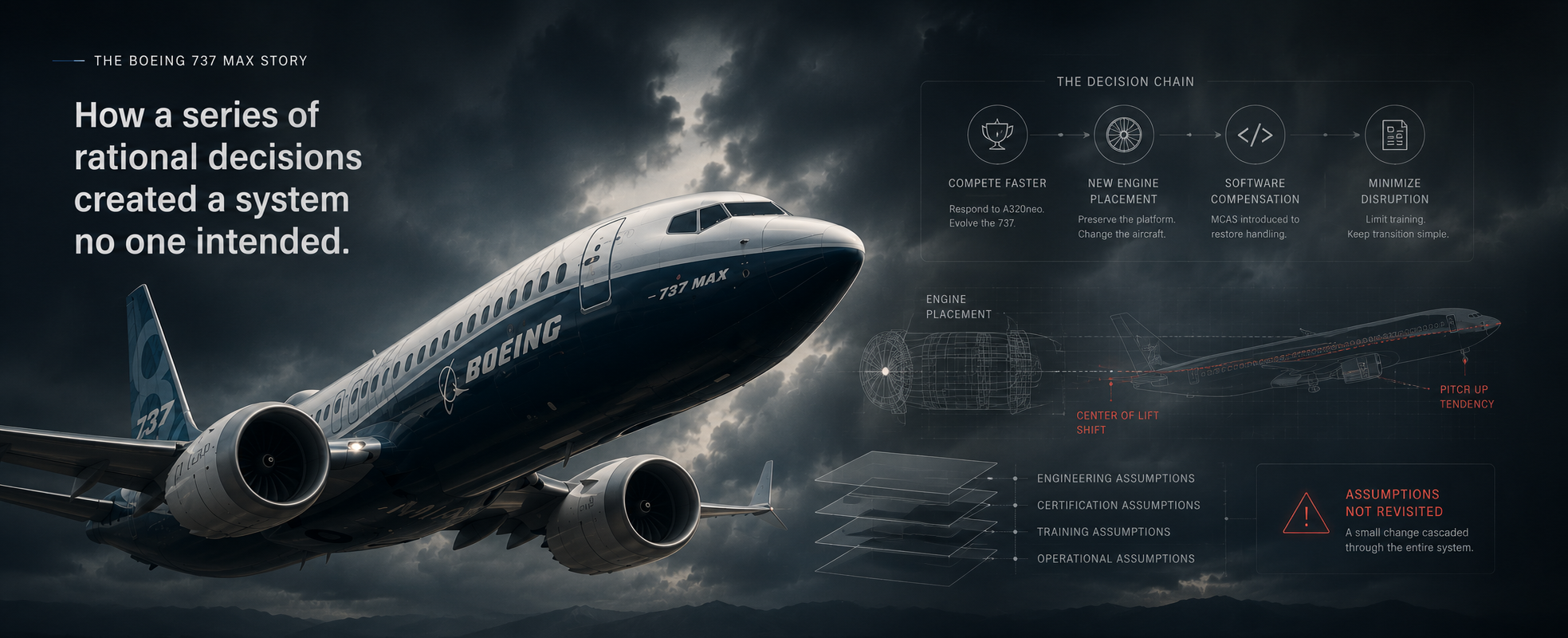
The Boeing 737 MAX: When Yesterday's Decisions Defined Tomorrow
There are failures caused by one bad decision.
Then there are failures where no single decision appears wrong.
The Boeing 737 MAX belongs to the second category.
The investigations that followed the Lion Air and Ethiopian Airlines crashes uncovered software issues, certification shortcomings, engineering compromises and organizational failures. Each investigation explained part of what happened.
Yet none fully answered the deeper question.
How did one of the world's greatest engineering companies gradually build a system nobody intended?
Perhaps because the story wasn't about one decision.
It was about what happened when every new decision quietly changed the assumptions behind the last.
01The first decision
In 2010, Airbus introduced the A320neo.
Instead of designing a new aircraft, Airbus equipped an existing platform with larger, more fuel-efficient engines. Airlines immediately saw the appeal: lower operating costs, minimal disruption and little additional pilot training.
Orders surged.
Boeing now faced a strategic dilemma.
Build an entirely new aircraft, requiring years of development.
Or evolve the existing 737 and respond far more quickly.
Neither option was irrational.
One optimized engineering.
The other optimized speed, cost and market timing.
Boeing chose to evolve the 737.
The decision solved the immediate competitive problem.
It also created the first constraint.
02The second decision
The larger engines no longer fit naturally beneath the 737's low wing.
Redesigning the aircraft would have undermined the very reason Boeing had chosen the existing platform.
Instead, the engines were moved higher and further forward.
The solution preserved the original strategy.
But it changed how the aircraft behaved during certain flight conditions.
The engineering problem had been solved.
The assumptions behind the original decision had quietly changed.
03The third decision
To restore handling characteristics familiar to pilots, Boeing introduced MCAS.
Again, the decision was rational.
Software allowed Boeing to compensate for the new flight characteristics without redesigning the aircraft.
But introducing MCAS changed more than engineering.
It changed certification.
It changed pilot training.
It changed operational assumptions.
Yet the earlier assumptions largely remained in place.
Each decision made sense on its own.
The interaction between those decisions became increasingly difficult to see.
04The fourth decision
By now, no single team owned the entire system.
Engineering focused on aircraft behavior.
Certification focused on regulatory approval.
Commercial teams focused on airline adoption.
Training focused on pilot transition.
Each function optimized the decision directly in front of it.
Very few were continuously asking a different question.
Does this new decision invalidate the assumptions that made our previous decisions acceptable?
That question slowly disappeared.
And with it, the ability to see how individual decisions were beginning to reshape the entire system.
05Looking back
Looking back, it's tempting to search for the one decision that caused the Boeing 737 MAX crisis.
There wasn't one.
The decision to evolve the 737 wasn't wrong.
Moving the engines wasn't irrational.
Introducing MCAS wasn't inherently a mistake.
Keeping pilot transition simple made commercial sense.
Individually, every decision addressed a genuine problem.
The challenge was that every new decision quietly changed the assumptions behind the previous one.
Yet those assumptions were rarely challenged again.
Perhaps that is the real lesson behind the Boeing 737 MAX.
Organizations rarely fail because one decision is wrong.
They fail when individually rational decisions accumulate without a structure that continually asks whether yesterday's assumptions are still valid in today's reality.
The Crossroads
Every organization eventually reaches its own crossroads. Sometimes it's technology, sometimes regulation, sometimes growth, sometimes identity.
The companies change. The industries change. The decisions change.
The underlying challenge rarely does.
Every critical business function has a Standard Operating Procedure.
Why don't decisions?
Explore the ISOFORM Framework →