Kodak: The Cost of Protecting Success
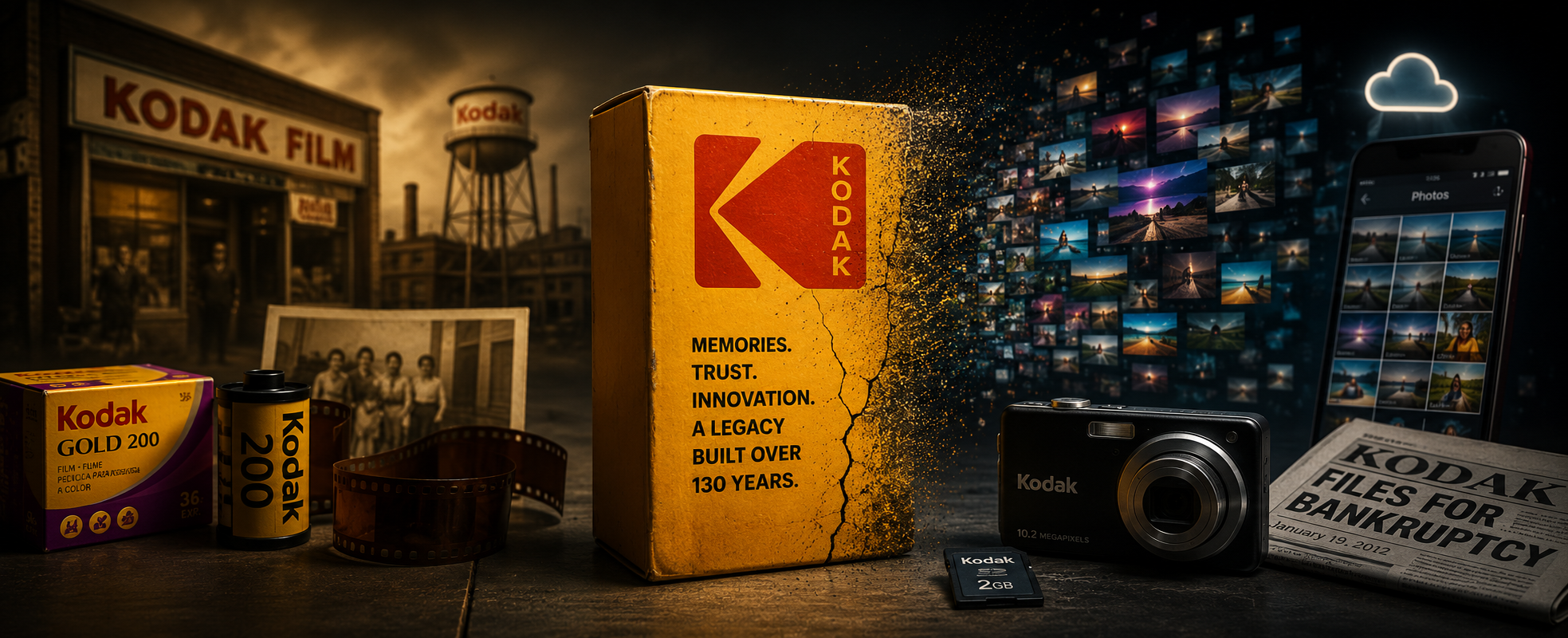
Kodak: The Cost of Protecting Success
There was a time when photography meant Kodak.
Not because Kodak made cameras.
Because Kodak made memories.
Its yellow film boxes sat in homes across the world. Families trusted Kodak to capture birthdays, weddings and holidays. For nearly a century, the company didn't simply dominate photography.
It defined it.
Ironically, Kodak also helped invent the technology that would eventually reshape the industry. In 1975, engineer Steve Sasson built the world's first digital camera inside Kodak's own laboratories.
The future wasn't invisible.
It had already begun.
01Seeing the future wasn't the problem
Kodak understood digital photography long before most of the industry. It invested billions of dollars in digital imaging, built one of the world's largest patent portfolios and repeatedly acknowledged that film would eventually decline.
The challenge wasn't seeing what was coming.
It was deciding what to do with that knowledge.
Film wasn't simply Kodak's biggest product.
It was Kodak's business model.
Digital represented the future.
Film funded the present.
Every step towards one accelerated the decline of the other.
02The market changed faster than the economics
For decades, Kodak's success came from an ecosystem built around film. Customers bought cameras once, but they kept buying film, paying for developing and printing photographs. Every picture generated revenue several times over.
Digital photography broke that model. Consumers stopped buying film. Photographs no longer needed laboratories. Then smartphones made carrying a dedicated camera increasingly unnecessary. Photography hadn't disappeared.
Its economics had.
The market wasn't asking Kodak to build a better camera anymore.
It was asking the company to rethink what photography had become.
03Success made change harder
Kodak didn't lack innovation.
It lacked the freedom to abandon what had already made it successful.
Factories, supply chains, retail partnerships and decades of investment were all built around film. Every additional investment made preserving that system seem rational. Every year made the transition more expensive. Every delay became easier to justify.
Eventually, the question was no longer:
Can digital replace film?
It became:
Can Kodak afford to replace the business that made Kodak successful?
Those are fundamentally different decisions.
04The transition never caught up
Kodak continued investing. It launched digital cameras, acquired technology companies, restructured operations, closed factories and eliminated tens of thousands of jobs.
But the market continued moving. Software became more valuable than hardware. Sharing became more valuable than printing. Smartphones absorbed cameras altogether.
By the time Kodak filed for Chapter 11 bankruptcy protection in 2012, the industry had already moved to a world the company had spent years trying to catch.
The collapse wasn't caused by one bad decision.
It was the cumulative effect of hundreds of reasonable decisions made while the basis of competition kept changing.
05Looking back
Looking back, Kodak's story isn't about failing to invent digital photography.
It did.
Nor is it about failing to recognize disruption.
It recognized the shift years before most of the industry.
The harder question is what happens when every step towards the future weakens the business that funds the present.
The challenge wasn't choosing between film and digital.
It was deciding when the future had become more important than protecting the success of the past.
When should tomorrow become more valuable than today?
The Crossroads
Every organization eventually reaches its own crossroads. Sometimes it's technology, sometimes regulation, sometimes growth, sometimes identity.
The companies change. The industries change. The decisions change.
The underlying challenge rarely does.
Every critical business function has a Standard Operating Procedure.
Why don't decisions?
Explore the ISOFORM Framework →